
← See Stata 19's new features
Highlights
Corrected correlations for statistical artifacts
Measurement error (ME)
Indirect and direct range restriction (RR)
Artificial dichotomization
Small-study bias
Flexible data setup
Mixture of restricted and unrestricted reliability estimates for ME correction
Mixture of true- and observed-score \(u\) ratios for RR correction
Individual-correction meta-analysis
Bare-bones meta-analysis
Credibility intervals
Seamless integration with Stata’s meta suite
Forest plots
Funnel plots
Subgroup, cumulative, and leave-one-out analyses
Meta regression
See more meta-analysis features
Use the new meta psycorr command to perform psychometric meta-analysis. Combine corrected correlations that account for measurement error, range restrictions, and more. This feature is a part of StataNow™.
Meta-analysis often focuses on comparing binary or continuous outcomes between two distinct groups (new medication versus placebo, or teaching method A versus teaching method B). It is a powerful tool for summarizing effect sizes across studies.
But what if you are interested in the relationship between two variables—like job satisfaction and employee performance or mindful eating and self-regulation—across dozens of studies? And what if your variables are not directly observed but measured with noisy instruments or within limited sample ranges?
Such challenges are precisely what psychometric meta-analysis is designed to address.
Psychometric meta-analysis (Schmidt and Hunter 2015) does not just pool correlations—it corrects them for the statistical artifacts that threaten to distort the truth. Think measurement error, range restriction, dichotomization, and small-sample bias. These are not side notes; they are central concerns when dealing with latent constructs like intelligence, well-being, or motivation.
Stata's new meta psycorr command makes psychometric meta-analysis straightforward, enabling you to compute corrected correlations and standard errors and to declare your dataset as ready for downstream analysis using the full meta suite.
-> The saga continues: Can mindful eating reshape your self-control?
-> Understanding the data and the artifacts
-> Correcting for measurement error and range restriction
-> Exploring alternative settings
-> Meta-analysis summary and visualizing results
-> Other artifacts and modeling bivariate range restriction
-> Subgroup meta-analysis
The lentil sliders and other legume-based menu items were a hit thanks to your meta-analysis (MA) of correlations. Your future mother-in-law is setting her sights higher: writing a book on mindful eating. But she is determined to ground her claims in science, not speculation.
She has heard whispers in the wellness world that mindful eating (eating slowly, without distractions, and listening to hunger and fullness cues) may be linked to improved self-control (the ability to regulate impulses and stay focused on long-term goals rather than short-term temptations), lower BMI, and even reduced anxiety. She wants to know the following: Is there solid evidence that mindful eating truly correlates with better psychological outcomes?
Lucky for her, you are the in-house meta-analyst.
You gather 13 studies measuring the correlation between mindful eating (T) and self-control (P).
. use mesc
(Fictional data of correlations between mindful eating and self-control)

. describe


Contains data from mesc.dta
 Observations:            13                  Fictional data of correlations
                                                between mindful eating and
                                                self-control
    Variables:             7                  4 Jun 2025 03:05
| Variable Storage Display Value |
| name type format label Variable label |
| studylbl str23 %23s Study label rxyr float %8.0g Observed XY correlation in the restricted sample n int %8.0g Study sample size rxxr float %8.0g Reliability estimates for X in restricted sample ryyr float %8.0g Reliability estimates for Y in restricted sample ux float %8.0g Std. dev. ratio (restricted/unrestricted) of X agegroup byte %30.0g agegrplbl Study age group |
T and P are latent constructs, which cannot be measured directly. The studies used questionnaires with items aimed at measuring T and P, but these constructs are measured with error. The reliability estimates of measuring T and P using instruments (questionnaire scores) x and y, respectively, are stored in variables rxxr and ryyr.
But there is more. Participants were not selected randomly. Studies drew from a restricted sample that is composed of individuals selected based on a latent suitability variable (let's call it s) that combines age, gender, health consciousness, and general motivation. While s is not observed directly, its effect is clear: participants were filtered through a nonrandom process.
In fact, this filtering likely happened in two stages:
1. A broader pool of participants first entered the study pipeline (for example, applied, were recruited, or completed initial surveys). This forms the unrestricted sample.
2. From this pool, a final restricted sample was selected based on s, reducing the variability in mindful eating scores (x) and distorting the observed correlation.
This, you explain, is a textbook case of indirect range restriction. Under the full-mediation assumption—that is, assuming the effect of selection (based on s) on the outcome (self-control) is fully caused or mediated by the predictor (mindful eating)— we can apply a univariate correction for this bias.
It is called univariate because it requires information about the \(u\) ratio of only one of the two variables involved in the correlation—either the predictor or the outcome. The \(u\) ratio, stored in the variable ux, is the ratio of the standard deviation of x in the restricted sample to that in the unrestricted sample. A value less than 1 indicates that the variability of x has been reduced because of selection, which attenuates the observed correlation—meaning the correlation between x and y in the restricted sample, stored in variable rxyr, is smaller than what it would be in the unrestricted sample.
We may now use meta psycorr to correct for both measurement error and indirect range restriction, where variables n and studylbl represent the study sample size and label, respectively:
. meta psycorr rxyr n, xreliability(rxxr) yreliability(ryyr) xuratios(ux) studylabel(studylbl)

Psychometric meta-analysis setting information

 Study information
    No. of studies: 13
       Study label: studylbl
        Study size: _meta_studysize
      Summary data: rxyr n

       Effect size
              Type: correlation
             Label: Corrected correlation
          Variable: _meta_es

         Precision
         Std. err.: _meta_se
                CI: [_meta_cil, _meta_ciu]
          CI level: 95%

  Model and method
             Model: Random effects
            Method: Individual-correction meta-analysis

 Reliability for X
            Values: rxxr
              Type: restricted

 Reliability for Y
            Values: ryyr
              Type: restricted

 Range restriction
        u_X values: ux
          u_X type: observed
              Type: indirect
Briefly, meta psycorr reports that we are performing an individual-correction MA with 13 studies, under a random-effects model. We have specified reliability estimates for both variables (from the restricted sample) and provided \(u\) ratios for x, assuming indirect range restriction. Stata uses this information to correct observed correlations for measurement error and range restriction and compute their standard errors, storing the results in _meta_es and _meta_se, respectively. For a detailed interpretation of the output, see Example 2 of [META] meta psycorr and Meta settings with meta psycorr in [META] meta data.
We have assumed that range restriction is indirect, which is the most common assumption in practice and therefore is the default, but for illustration purposes, if we wish to assume that it is direct (for example, selection was based directly on x) and keep all other settings the same, then we can use meta update.
. meta update, direct

-> meta psycorr rxyr n , xreliability(rxxr) yreliability(ryyr) xuratios(ux) direct studylabel(studylbl)

Psychometric meta-analysis setting information from meta psycorr

 Study information
    No. of studies: 13
       Study label: studylbl
        Study size: _meta_studysize
      Summary data: rxyr n

       Effect size
              Type: correlation
             Label: Corrected correlation
          Variable: _meta_es

         Precision
         Std. err.: _meta_se
                CI: [_meta_cil, _meta_ciu]
          CI level: 95%

  Model and method
             Model: Random effects
            Method: Individual-correction meta-analysis

 Reliability for X
            Values: rxxr
              Type: restricted

 Reliability for Y
            Values: ryyr
              Type: restricted

 Range restriction
        u_X values: ux
          u_X type: observed
              Type: direct
Or perhaps, if you wish to assume that the reliability estimates come from the unrestricted sample and are stored in variable rxxu, then you type
. meta update, xreliability(rxxu, unrestricted)
(hypothetical example; no output)
Other examples of specifying information about the statistical artifacts are shown in examples 2–6 of [META] meta psycorr.
Continuing with our first specification of meta psycorr, let's summarize our meta-analysis, compute the overall (mean) corrected correlation, and display the 80% (default) credibility interval using option credinterval.
. meta summarize, credinterval

  Effect-size label: Corrected correlation
        Effect size: _meta_es
          Std. err.: _meta_se
        Study label: studylbl
     Correcting for: Measurement errors in X and Y.
                     Univariate indirect range restriction in X.

Meta-analysis summary                           Number of studies =     13
Random-effects model                            Heterogeneity:
Method: Individual-correction MA                            tau2 =  0.0338
                                                          I2 (%) =   79.02
                                                              H2 =    4.77

             Effect size: Corrected correlation
| Study | Effect size [95% conf. interval] % weight | |
| Maester Aemon (2010) | 0.411 0.159 0.662 4.41 | |
| Maester Luwin (2011) | 0.823 0.676 0.970 7.23 | |
| Maester Cressen (2012) | 0.548 0.411 0.684 14.19 | |
| Maester Pycelle (2013) | 0.703 0.527 0.879 6.31 | |
| Maester Marwyn (2014) | 0.264 -0.021 0.549 3.83 | |
| Maester Wolkan (2015) | 0.277 0.087 0.466 8.37 | |
| Maester Pylos (2016) | 0.220 0.036 0.403 9.03 | |
| Maester Ballabar (2017) | 0.538 0.363 0.713 9.58 | |
| Maester Vaellyn (2018) | 0.479 0.244 0.713 5.17 | |
| Maester Assaad (2019) | 0.606 0.420 0.792 6.82 | |
| Maester Norren (2020) | 0.170 -0.073 0.412 5.27 | |
| Maester Ryam (2021) | 0.748 0.617 0.879 12.90 | |
| Maester Orwel (2022) | 0.618 0.412 0.824 6.89 | |
| theta | 0.518 0.406 0.631 | |
The output header lists the artifacts used to correct the correlations for attenuation. The second column of the output table shows the individually corrected correlations, whereas the third and fourth columns present their corresponding 95% confidence intervals (CIs). The mean corrected correlation is 0.518 with a 95% CI of [0.406, 0.631]. We can also present the results of the psychometric meta-analysis and display the credibility interval graphically by using a forest plot.
. meta forestplot, credinterval
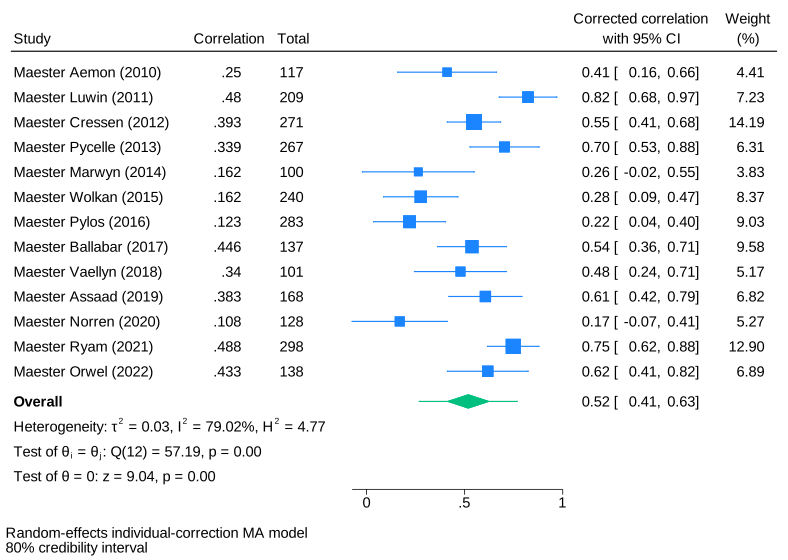
The overall effect size corresponds to the green diamond centered at the estimate of the mean corrected correlation. The width of the diamond corresponds to the width of the overall CI, [0.41, 0.63]. The green whiskers, extending from the overall diamond, span the width of the credibility interval displayed in meta summarize, [0.269, 0.768].
Other artifacts that you can account for are small-study bias and dichotomization of the scores of x and y; see Example 10 of [META] meta psycorr. When the full-mediation assumption is not met, you may still correct for indirect range restriction without relying on that assumption. However, this requires knowledge of the ratio of the standard deviations of y in the restricted group to the unrestricted group. Because this method requires knowledge of both \(u\) ratios for x and y, Wiernik and Dahlke (2020) referred to it as a bivariate indirect range restriction (BVIRR) correction method. For example, to correct for BVIRR, you will then type
. meta psycorr rxyr n, xreliability(rxxr) yreliability(ryyr) xuratios(ux) yuratios(uy)
(hypothetical example; no output)
Your mother-in-law is curious: does mindful eating link more strongly to self-control in certain groups, say, older adults versus younger adults?
You split the dataset using the agegroup variable and generate subgroup-specific forest plots:
. meta forestplot, subgroup(agegroup) esrefline insidemarker
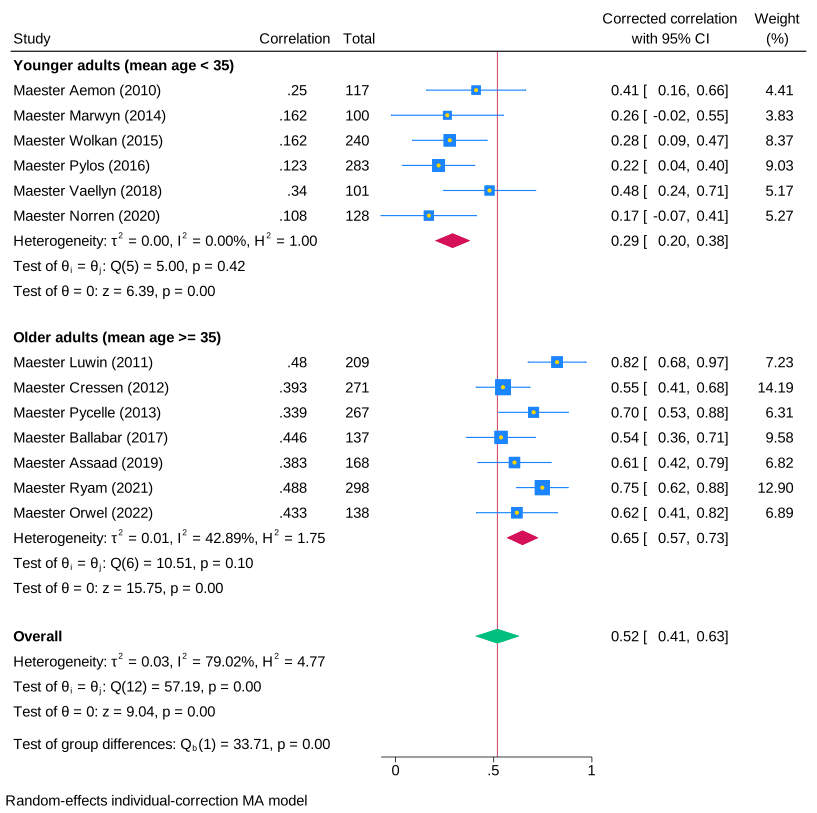
You find that older adults show a stronger corrected correlation (0.65 versus 0.29)—a result that fits with theories of increased self-regulation and healthier routines later in life.
Your future mother-in-law is thrilled. Thanks to your psychometric meta-analysis wizardry, the evidence is in: mindful eating and self-control really do go hand in hand—especially for the seasoned sages among us.
Schmidt, F. L., and J. E. Hunter. 2015. Methods of Meta-Analysis: Correcting Error and Bias in Research Findings. Third edition. Thousand Oaks, CA: Sage. https://doi.org/10.4135/9781483398105.
Wiernik, B. M., and Dahlke, J. A. 2020. Obtaining unbiased results in meta-analysis: The importance of correcting for statistical artifacts. Advances in Methods and Practices in Psychological Science. 3: 94–123. https://doi.org/10.1177/2515245919885611.
Read more about psychometric meta-analysis in [META] meta psycorr in the Stata Meta-Analysis Reference Manual; see Tour of meta-analysis commands in [META] meta.
Learn more about Stata's meta-analysis features.
View all the new features in Stata 19 and, in particular, new in meta-analysis.


