Survey and correlated data
Stata’s
svy: prefix
now works with
- Cox proportional hazards regression (stcox)
- Parametric hazard and accelerated time survival regression
(streg)
Twenty-five other commands also now support estimation with survey data.
You just declare the survey design for your data by using
svyset,
and then declare your data to be survival-time data by using
stset.
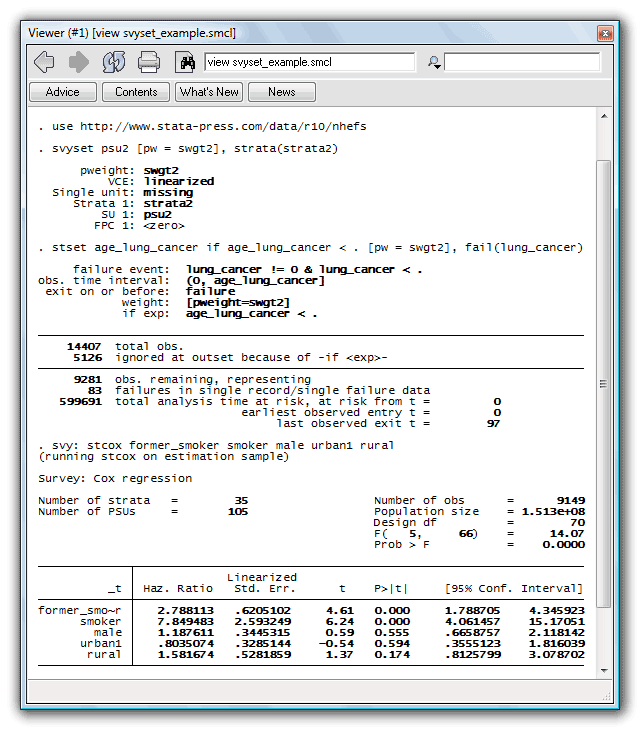
Here’s an example:
. use http://www.stata-press.com/data/r10/nhefs
. svyset psu2 [pw = swgt2], strata(strata2)
. stset age_lung_cancer if age_lung_cancer < . [pw = swgt2], fail(lung_cancer)
. svy: stcox former_smoker smoker male urban1 rural
We could just as easily have fitted a parametric survival regression
model simply by replacing
svy:stcox with
svy:streg.
Here’s a complete list of what’s new in statistics(survey)
-
Stata’s svy: prefix now works with 48
estimators, 27 more than previously.
Other commands with which svy: now works include
| biprobit |
bivariate probit regression |
|---|
| clogit |
conditional (fixed effects) logistic regression |
|---|
| cloglog |
complementary log-log regression |
|---|
| cnreg |
censored-normal regression |
|---|
| cnsreg |
constrained linear regression |
|---|
| glm |
generalized linear models |
|---|
| hetprob |
heteroskedastic probit regression |
|---|
| ivregress |
instrumental-variables regression |
|---|
| ivprobit |
probit model with endogenous regressors |
|---|
| ivtobit |
tobit model with endogenous regressors |
|---|
| mprobit |
multinomial probit regression |
|---|
| nl |
nonlinear least-squares estimation |
|---|
|
| scobit |
skewed logistic regression |
|---|
| slogit |
stereotype logistic regression |
|---|
| stcox |
Cox proportional hazards regression |
|---|
| streg |
parametric survival regression (five estimators) |
|---|
| tobit |
tobit regression |
|---|
| treatreg |
treatment-effects model |
|---|
| truncreg |
truncated regression |
|---|
| zinb |
zero-inflated negative binomial regression |
|---|
| zip |
zero-inflated Poisson regression |
|---|
| ztnb |
zero-truncated negative binomial regression |
|---|
| ztp |
zero-truncated Poisson regression |
|---|
|
See [SVY] svy
estimation.
-
svy: prefix now calculates the linearized
variance estimator two to 100 times faster, the larger multiplier applying
to large datasets with many sampling units; see [SVY]
svy.
-
svy: mean,
svy: proportion,
svy: ratio, and
svy: total
are considerably faster when the over() option
identifies many subpopulations.
-
svy:,
svy: mean,
svy: proportion,
svy: ratio, and
svy: total now take advantage
of multiple processors in Stata/MP, making them even faster.
-
Concerning svyset,
-
New option
singleunit(method)
provides three methods for handling strata with one sampling unit. If
not specified, the default in such cases is to report standard errors
as missing value.
-
New option fay(#)
specifies that Fay’s adjustment be made to the BRR weights.
See [SVY] svyset.
-
estat has
two new subcommands for use with
svy estimation
results:
-
estat sd, used after
svy: mean, reports subpopulation standard
deviations.
-
estat strata reports the number of singleton
and certainty strata within each sampling stage.
See [SVY] estat.
-
svy: tabulate now allows string variables. See [SVY]
svy: tabulate oneway and [SVY]
svy: tabulate twoway.
-
Existing command
svydes
has been renamed svydescribe;
svydes continues to work.
svydescribe now puts missing values in the
generate(newvar)
variable for observations outside the specified estimation sample.
Previously, the variable would contain a zero for observations outside the
estimation sample. See [SVY]
svydescribe.
-
The [SVY] manual has been reorganized. Stata’s survey estimation
commands are now documented in [SVY]
svy
estimation. All model-specific information is now documented in the
manual entry for the corresponding estimation command.
Back to highlights