1 item has been added to your cart.

Updates to Stata's graphic features were introduced in Stata 11.
|
| Order |
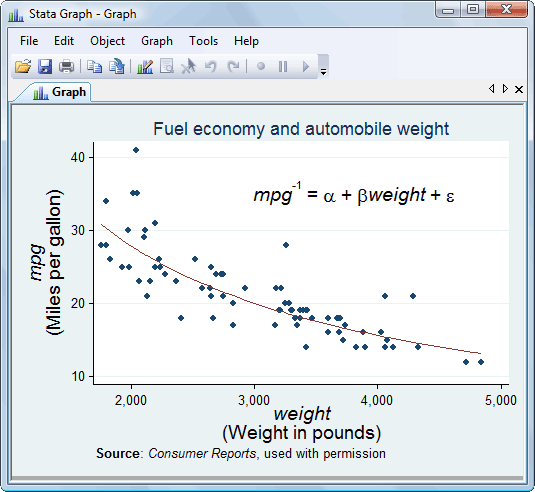
You can now include multiple fonts in regular, bold, and italics; the full Greek alphabet in upper- and lowercase; and over 70 mathematical symbols anywhere that text appears in graphs.
Graphs now accept an extended version of Stata’s text markup language, SMCL. Greek letters and mathematical symbols have intuitive, easy-to-remember names (tags). To make the title of the x axis of your graph say “β-carotene”, you just specify xtitle(“{&beta}-carotene”). To include χ2 in your text, specify {&chi} {superscript:2} or, even shorter, {&chi}{sup:2}. Additional tags make it easy to select from among sans serif, serif, monospace, and symbol fonts.
Here are a few other examples. Click on them to enlarge them.
;) |
;) |
;) |
;) |
Of course, these new features are also available via the dialog boxes and through the interactive Graph Editor.
Here is a complete list of what’s new in Stata graphics:


