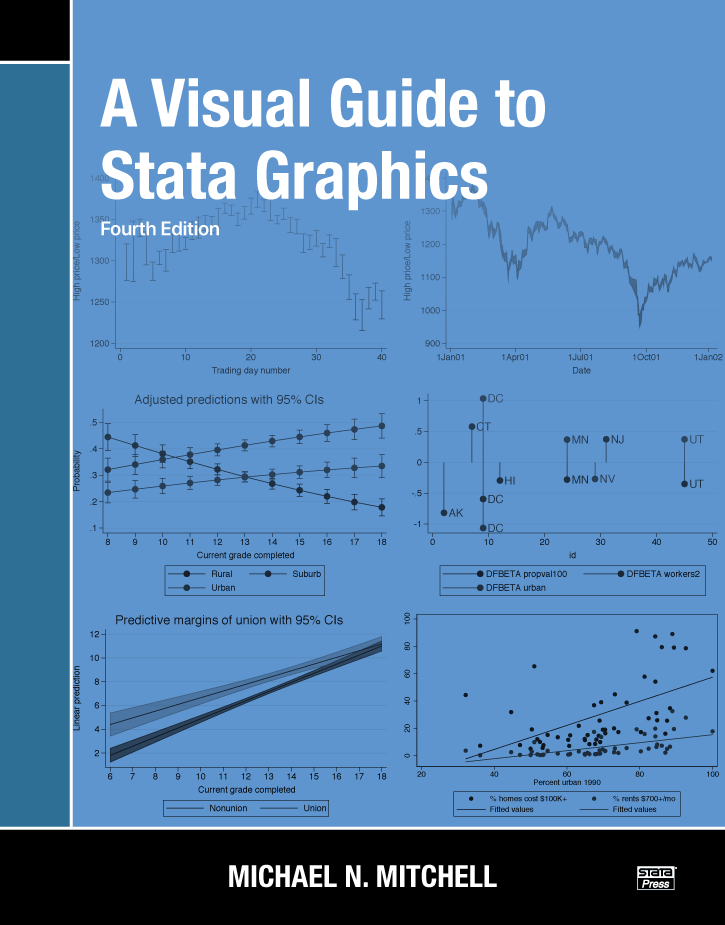
A Visual Guide to Stata Graphics, Third Edition
Author: |
Michael N. Mitchell |
| Publisher: |
Stata Press |
| Copyright: |
2012 |
| ISBN-13: |
978-1-59718-106-8 |
| Pages: |
499; paperback |
| Price: |
$62.00 |
|
|
|
|
Comment from the Stata technical group
In its third edition, Michael Mitchell’s A Visual Guide to
Stata Graphics remains the essential introduction and reference for
Stata graphics. The third edition retains all the features that made the
first two editions so useful:
- A complete guide to Stata’s graph
command and Graph Editor
- Exhaustive examples of customized graphs using both command
options and the Graph Editor
- Visual indexing of features—just look for a
picture that matches what you want to do
New in this edition are treatments of contour plots, margins plots, and font
handling. Mitchell dedicates a new subsection to contour plots, showing
you how to control the number of levels, how to change the colors used, and how to
produce effective legends. Over 30 graphs are used to demonstrate what you
can accomplish with the new marginsplot command—graphs
of estimated means and marginal means (with confidence intervals),
interaction graphs, comparisons of groups, and more. Mitchell also adds a
section that shows you how to get bold text, italic text, subscripts,
superscripts, and Greek letters into your titles, axes, labels, and other
text.
The book retains its visual style, presenting the reader with a color-coded,
visual table of contents that runs along the right edge of every page and
shows readers exactly where they are in the book. You can see the
color-coded chapter tabs without opening the book, providing quick visual
access to each chapter.
The heart of each chapter is a series of entries that are typically
formatted three to a page. Each entry shows a graph command (with the
emphasized portion of the command highlighted in red), the resulting graph,
a description of what is being done, the dataset and scheme used, and a
section showing how to produce the result by using the Graph Editor. Because
every feature, option, and edit is demonstrated with a graph or screen
capture, you can often flip through a section of the book to find exactly
the effect you are seeking.
The first chapter details how to use the book, the types of Stata graphs,
how to use schemes to control the overall appearance of graphs, and how to
use options to make specific modifications. It also outlines a process for
building graphs with the graph command.
The second chapter is a complete overview of the Graph Editor. It includes
over 120 color graphics and screen captures to show exactly how things are
done and how they look on the graph. With pictures and words,
Mitchell shows how to change the color, size, or placement of any
titles, markers, annotations, or other objects on your graph by using just a
few mouse clicks. More subtly, he shows how to change things such as
the number of ticks and labels on your axes, the number of columns in your
legends, the label on an individual point, and more. He even shows how
to convert, for example, a scatterplot to a line plot and how to rotate or
pivot bar charts. Mitchell also covers advanced topics such as how to draw
lines and arrows on graphs so that they continue to reference your objects
of interest even if you resize the graph, combine it with other graphs, or
change the scale or range of the axes. In short, he exposes all the Graph
Editor’s tools, from the simplest to the most powerful. Mitchell does
not stop there; almost every example in the book shows you how to accomplish
the desired graph or effect not only by using a command or command-line
option but also by using the Graph Editor.
Of the Graph Editor, Mitchell writes,
[...] You need to use the Graph Editor for only a short amount of
time to see what a smart and powerful tool it is. Whereas commands
offer the power of repeatability, the Graph Editor provides a
nimble interface that permits you to tangibly modify graphs like a
potter directly handling clay.
In the third chapter, Mitchell discusses
twoway graphs such as scatterplots, line plots, area plots, bar plots, range
plots, contour plots, regression fits, and smooths. He shows how to
create each of these types of graphs and how to use options (and the Graph
Editor) to control how the graph looks. He also introduces graphing across
groups of data and options for adding and controlling titles, notes,
legends, and so forth. Beyond the basics, he shows how to easily overlay
plots to obtain graphs such as regression fits with error contours
and observed data scatters, local polynomial smooths with scatters of their
underlying data, stock market–style graphs of open and closed values with
quantities traded as a bar chart at the bottom, histograms with density
smooths, and more. Because Stata’s graph command will let you
customize any aspect of the graph, Mitchell spends ample time showing you
the most valuable options for obtaining the look you want.
If you are in a hurry to discover one special option, you can
skim the chapter until you see the effect you want, and then glance at the
command to see what is highlighted in red.
In the succeeding five chapters, Mitchell covers scatterplot matrices, bar
graphs, box plots, dot plots, and pie charts. As with twoway graphs, he
shows you how to create each of these graphs and how to adjust every aspect
of the graph to your taste (or to a publisher’s required form).
In chapters 9 and 10, Mitchell undertakes an in-depth presentation of the
options available across almost all graph types—options
that add and change the look of titles, notes, and such; control the number
of ticks on axes; control the content and appearance of the numbers and
labels on axes; control legends; add and change the look of annotations;
graph over subgroups; change the look of markers and their labels; apply
schemes to control the look of the graph; change the look of graph regions;
size graphs and their elements; and more. Again he shows how to make
these changes both by using options and by using the Graph Editor.
To complete the graphical journey, Mitchell discusses and demonstrates the
12 styles that unite and control the appearance of the myriad
graph objects. These styles are angles, colors, clock positions, compass
directions, connecting points, line patterns, line widths, margins, marker
sizes, orientations, marker symbols, and text sizes.
That completes the main body of the Visual Guide, but don’t
skip the appendix. There, Mitchell first gives a quick overview of the
dozens of statistical graph commands that are not strictly the subject of
the book. Even so, these commands use the graph command as an engine to draw
their graphs; therefore, almost all that Mitchell has discussed applies
to them. To make this clear, he shows explicitly how to apply common options
and common Graph Editor tools to statistical graphs. Then Mitchell takes
you on a tour of the new marginsplot command. After that, he
addresses combining graphs—showing you how to create complex and
multipart images from previously created graphs.
In a crucial section entitled “Putting it all together”,
Mitchell shows us how to do just that. We learn more about overlaying twoway
plots, and we learn how to combine data management and graphics to create
plots such as bar charts of rates with capped confidence intervals,
scatterplots with range-finder confidence intervals in both dimensions, and
population pyramids.
Mitchell then warns us about mistakes that can be made when typing graph
commands and how to correct them. In the appendix, he even show us how to
create our own scheme files. Scheme files allow you to control every aspect
of how your graphs look without having to specify options. They are the
answer to department or journal standards or if you just want all your
graphs to have a common appearance different from the schemes shipped
with Stata. As with the rest of the book, this section includes
cross-references to the Stata Graphics Reference Manual to provide more
depth on the subject. Finally, Mitchell reviews all datasets, schemes,
and other online supplements available for the book.
The third edition of A Visual Guide to Stata Graphics is a complete
guide to Stata’s graph command and the associated Graph Editor.
Whether you want to tame the Stata graph command, quickly find out how to
produce a graphical effect, master the Stata Graph Editor, or learn
approaches that can be used to construct custom graphs, this is the book to
read.
Table of contents
Dedication
Acknowledgments
1 Introduction
1.1 Using this book
1.2 Types of Stata graphs
1.3 Schemes
1.4 Options
1.5 Building graphs
2 Editor
2.1 Overview of the Graph Editor
2.2 Object Browser
2.3 Modifying objects
2.4 Adding objects
2.5 Moving objects
2.6 Hiding and showing objects
2.7 Locking and unlocking objects
2.8 Using the Graph Recorder
2.9 Graph Editor versus Stata commands
3 Twoway graphs
3.1 Scatterplots
3.2 Regression fits and splines
3.3 Regression confidence interval fits
3.4 Line plots
3.5 Area plots
3.6 Bar plots
3.7 Range plots
3.8 Distribution plots
3.9 Contour plots
3.10 Options
3.11 Overlaying plots
4 Scatterplot matrix graphs
4.1 Marker options
4.2 Controlling axes
4.3 Matrix options
4.4 Graphing by groups
5 Bar graphs
5.1 Y variables
5.2 Graphing bars over groups
5.3 Options for controlling gaps between bars
5.4 Options for sorting bars
5.5 Controlling the categorical axis
5.6 Legends and labeling bars
5.7 Controlling the y axis
5.8 Changing the look of bars
5.9 Graphing by groups
6 Box plots
6.1 Specifying variables and groups
6.2 Options for controlling gaps between boxes
6.3 Options for sorting boxes
6.4 Controlling the categorical axis
6.5 Controlling legends
6.6 Controlling the y axis
6.7 Changing the look of boxes
6.8 Graphing by groups
7 Dot plots
7.1 Specifying variables and groups
7.2 Options for controlling gaps between dots
7.3 Options for sorting dots
7.4 Controlling the categorical axis
7.5 Controlling legends
7.6 Controlling the y axis
7.7 Changing the look of dot rulers
7.8 Graphing by groups
8 Pie charts
8.1 Types of pie charts
8.2 Sorting pie slices
8.3 Changing the look and color and exploding pie slices
8.4 Slice labels
8.5 Controlling legends
8.6 Graphing by groups
9 Options available for most graphs
9.1 Changing the look of markers
9.2 Creating and controlling marker labels
9.3 Connecting points and markers
9.4 Setting and controlling axis titles
9.5 Setting and controlling axis labels
9.6 Controlling axis scales
9.7 Selecting an axis
9.8 Graphing by groups
9.9 Controlling legends
9.10 Adding text to markers and positions
9.11 Options for text and textboxes
9.12 More options controlling the display of text
10 Standard options available for all graphs
10.1 Creating and controlling titles
10.2 Using schemes to control the look of graphs
10.3 Sizing graphs and their elements
10.4 Changing the look of graph regions
11 Styles for changing the look of graphs
11.1 Angles
11.2 Colors
11.3 Clock position
11.4 Compass direction
11.5 Connecting points
11.6 Line patterns
11.7 Line width
11.8 Margins
11.9 Marker size
11.10 Orientation
11.11 Marker symbols
11.12 Text size
12 Appendix
12.1 Overview of statistical graph commands
12.2 Common options for statistical graphs
12.3 The marginsplot command
12.4 Saving, redisplaying, and combining graphs
12.5 More examples: Putting it all together
12.6 Common mistakes
12.7 Customizing schemes
12.8 Online supplements
|