1 item has been added to your cart.

An Introduction to Modern Econometrics Using Stata |
||||||||||||||||||||||||||||||||||||||
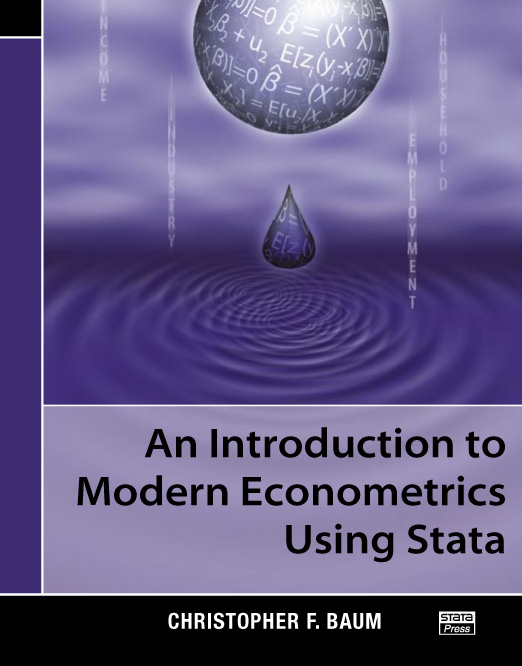 Click to enlarge See the back cover |
$68.00 Print Add to cart$54.00 Amazon Kindle Buy from Amazon
As an Amazon Associate, StataCorp earns a small referral credit from
qualifying purchases made from affiliate links on our site.
|
Preface
Author index Subject index Errata Download the datasets used in this book (from stata-press.com) Review from the Stata Journal |
||||||||||||||||||||||||||||||||||||
Comment from the Stata technical groupAn Introduction to Modern Econometrics Using Stata, by Christopher F. Baum, successfully bridges the gap between learning econometrics and learning how to use Stata. The book presents a contemporary approach to econometrics, emphasizing the role of method-of-moments estimators, hypothesis testing, and specification analysis while providing practical examples showing how the theory is applied to real datasets by using Stata. The first three chapters are dedicated to the basic skills needed to effectively use Stata: loading data into Stata; using commands like generate and replace, egen, and sort to manipulate variables; taking advantage of loops to automate tasks; and creating new datasets by using merge and append. Baum succinctly yet thoroughly covers the elements of Stata that a user must learn to become proficient, providing many examples along the way. Chapter 4 begins the core econometric material of the book and covers the multiple linear regression model, including efficiency of the ordinary least-squares estimator, interpreting the output from regress, and point and interval prediction. The chapter covers both linear and nonlinear Wald tests, as well as constrained least-squares estimation, Lagrange multiplier tests, and hypothesis testing of nonnested models. Chapters 5 and 6 focus on consequences of failures of the linear regression model’s assumptions. Chapter 5 addresses topics like omitted-variable bias, misspecification of functional form, and outlier detection. Chapter 6 is dedicated to non-independently and identically distributed errors, and it introduces the Newey–West and Huber/White covariance matrices, as well as feasible generalized least-squares estimation in the presence of heteroskedasticity or serial correlation. Chapter 7 is dedicated to the use of indicator variables and interaction effects. Instrumental-variables estimation has been an active area of research in econometrics, and chapter 8 commendably addresses issues like weak instruments, underidentification, and generalized method-of-moments estimation. In this chapter, Baum extensively uses his wildly popular ivreg2 command. The last two chapters briefly introduce panel-data analysis and discrete and limited-dependent variables. Two appendices detail importing data into Stata and Stata programming. As in all chapters, Baum presents many Stata examples. An Introduction to Modern Econometrics Using Stata can serve as a supplementary text in both undergraduate- and graduate-level econometrics courses, and the book’s examples will help students quickly become proficient in Stata. The book is also useful to economists and businesspeople wanting to learn Stata by using practical examples. Comments from readersThis book provides an excellent resource for both teaching and learning modern microeconometric practice, using the most popular software package in this area. The coverage includes discrete choice models and models for panel data, as well as linear regression and instrumental variables methods. I particularly like the material on handling large datasets and developing efficient programs within Stata, which provide the reader with an invaluable introduction to good practice in empirical research.
Prof. Steve Bond Kit Baum provides students and researchers a hands-on guide to modern econometric techniques by means of many well-documented examples in Stata. The examples are also useful templates for those who need to write Stata routines for their own work. Treatment and transformation of cross-section, time-series, and panel data are carefully explained. The coverage of the text is broad and up to date. An Introduction to Modern Econometrics Using Stata is a valuable companion to undergraduate- and graduate-level econometric textbooks.
Serena Ng Christopher Baum’s An Introduction to Modern Econometrics Using Stata is probably the only econometrics text published to date that pays serious attention to reproducibility of research and systematic data validation using Stata’s data audit commands along with do-file and programming capabilities. Economic and financial consultants will find this text to be an invaluable guide to using Stata for creating reproducible, error-free data and econometric analysis, as well as quality graphic presentations. The book is comprehensive and easy to follow, with substantive coverage of econometric theory and applications using the full array of Stata’s capabilities. This text should serve as an excellent learning and reference guide for every consultant.
Zaur Rzakhanov, Ph.D. This book is a wonderful complement to the Stata technical manuals. It provides a wealth of practical tips and sample applications that help the intermediate-level Stata user advance in making the most efficient use of Stata. It is thoughtfully organized along the lines of an econometrics textbook, allowing practitioners to find relevant and useful commands, procedures, and examples by topics that are familiar and immediate. It also includes a most helpful appendix for novice programmers that will expedite their development into proficient Stata programmers. This book is a must-have reference for any organization that needs to train practitioners of econometrics in the use of Stata.
Peter Boberg For too long there has been a hole in the field between econometrics textbooks, which focus on theory but give little practical guidance to the day-to-day realities of economic research, and software manuals, which provide detail but little analytical context. Researchers, analysts, and students have no single source to turn to and often waste valuable time and effort reinventing the wheel. This book brings it all together and gives the researcher a huge step up on the learning curve. It perhaps should have been subtitled “How to perform high-quality empirical research using Stata.” It addresses topics in the order that real-world research is performed, beginning with the data-management and quality-control issues that a researcher must contend with every day and then proceeding to the econometric tools used for most empirical analyses. A researcher or a research analyst reading this book would learn insights and tricks of the trade that would otherwise take years to accumulate. Common errors (such as those resulting from many-to-many merges) are pointed out. Useful tips (such as the use of local macros) are discussed. Efficient and robust programming is encouraged throughout. This book should be required reading for any empirical researcher or research analyst interested in developing a high-quality research process.
Dr. Paul Liu |
||||||||||||||||||||||||||||||||||||||
About the authorChristopher F. Baum is an economist at Boston College, where he codirects the undergraduate minor in scientific computation. He is an associate editor of the Stata Journal and co-organizer of Stata Users Group meetings in Boston. Baum has coauthored many Stata routines and maintains the Statistical Software Components archive of downloadable Stata packages. He has taught econometrics at the undergraduate and graduate levels, making extensive use of Stata, for many years. |
||||||||||||||||||||||||||||||||||||||
Table of contentsView table of contents >> |
||||||||||||||||||||||||||||||||||||||



