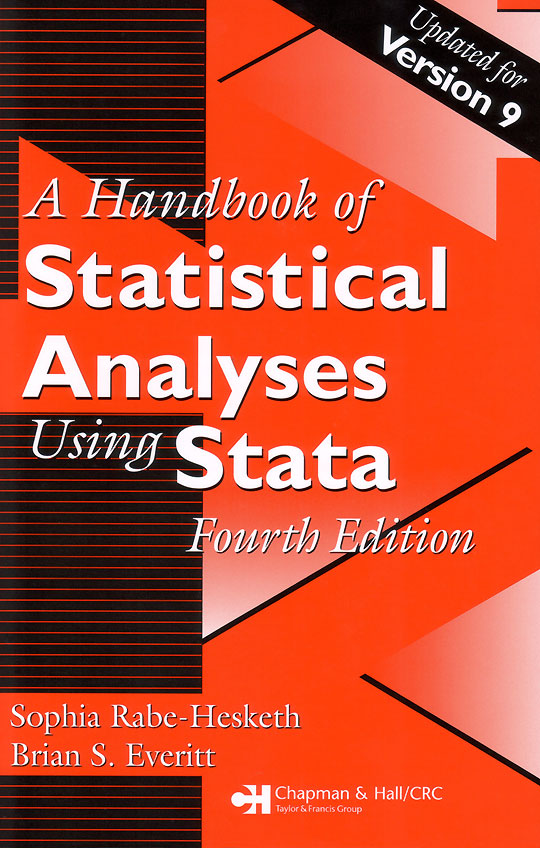
A Handbook of Statistical Analyses Using Stata, Fourth Edition
Authors: |
Sophia Rabe-Hesketh and Brian Everitt |
| Publisher: |
Chapman & Hall/CRC |
| Copyright: |
2007 |
| ISBN-13: |
978-1-58488-756-0 |
| Pages: |
352; paperback |
| Price: |
$59.50 |
|
|
|
|
Comment from the Stata technical group
The fourth edition of A Handbook of Statistical Analyses Using Stata,
by Sophia Rabe-Hesketh and Brian Everitt, is now available and incorporates
many of the features introduced in Stata 9. The book provides practical
examples of using Stata for real-world analysis. It begins with a concise
41-page introduction to Stata and progresses to intermediate topics such as
multiple regression, ANOVA, and logistic regression. Chapter-length
discussions cover more advanced topics, such as the generalized linear model
(GLM), survival analysis, maximum likelihood estimation, cluster analysis,
and principal components analysis.
The most distinguishing feature of this text is its use of case studies to
help users learn Stata’s capabilities in the various subfields of
statistics, including generalized linear models, survival analysis, panel
(longitudinal) data, and cluster analysis. For example, the discussion of
survival analysis revolves around a study of methadone maintenance treatment
to aid heroin addicts in overcoming their addiction.
A Handbook of Statistical Analysis Using Stata would make an
excellent supplemental textbook in a course in statistics, allowing students
to learn Stata on their own while reviewing concepts taught during lectures.
The book will also help practitioners, particularly those in
biostatistics and the health sciences, to become proficient with Stata
quickly.
Table of contents
Preface
1 A Brief Introduction to Stata
1.1 Getting help and information
1.2 Running Stata
1.3 Conventions used in this book
1.4 Datasets in Stata
1.5 Stata commands
1.6 Data management
1.7 Estimation
1.8 Graphics
1.9 Stata as a calculator
1.10 Matrix calculations using Mata
1.11 Brief introduction to programming
1.12 Keeping Stata up to date
1.13 Exercises
2 Data Description and Simple Inference: Female
Psychiatric Patients
2.1 Description of data
2.2 Group comparison and correlations
2.3 Analysis using Stata
2.4 Exercises
3 Multiple Regression: Determinants of Pollution in
U.S. Cities
3.1 Description of data
3.2 The multiple regression model
3.3 Analysis using Stata
3.4 Exercises
4 Analysis of Variance I: Treating Hypertension
4.1 Description of data
4.2 Analysis of variance model
4.3 Analysis using Stata
4.4 Exercises
5 Analysis of Variance II: Effectiveness of Slimming
Treatment
5.1 Description of data
5.2 Analysis of variance model
5.3 Analysis using Stata
Exercises
6 Logistic Regression: Treatment of Lung Cancer and Diagnosis of Heart Attacks
6.1 Description of data
6.2 The logistic regression model
6.3 Analysis using Stata
6.4 Exercises
7 Generalized Linear Models: Australian School
Children
7.1 Description of data
7.2 Generalized linear models
7.3 Analysis using Stata
7.4 Exercises
8 Summary Measure Analysis of Longitudinal Data: Treatment of Post-Natal Depression
8.1 Description of data
8.2 The analysis of longitudinal data
8.3 Analysis using Stata
8.4 Exercises
9 Random Effects Models: Thought disorder and schizophrenia
9.1 Description of data
9.2 Random effects models
9.3 Analysis using Stata
9.4 Thought disorder data
9.5 Exercises
10 Generalized Estimating Equations: Epileptic Seizures and Chemotherapy
10.1 Description of data
10.2 Generalized estimating equations
10.3 Analysis using Stata
10.4 Exercises
11 Some Epidemiology
11.1 Description of data
11.2 Introduction to epidemiology
11.3 Analysis using Stata
11.4 Exercises
12 Survival Analysis: Retention of Heroin Addicts in Methadone Maintenance Clinics
12.1 Description of data
12.2 Survival analysis
12.3 Analysis using Stata
12.4 Exercises
13 Maximum Likelihood Estimation: Age of Onset of
Schizophrenia
13.1 Description of data
13.2 Finite mixture distributions
13.3 Analysis using Stata
13.4 Exercises
14 Principal Components Analysis: Hearing Measurement
Using an Audiometer
14.1 Description of data
14.2 Principal component analysis
14.3 Analysis using Stata
14.4 Exercises
15 Cluster Analysis: Tibetan Skulls and Determinants of Pollution in U. S. Cities
15.1 Description of data
15.2 Cluster analysis
15.3 Analysis using Stata
15.4 Exercises
Appendix: Answers to Selected Exercises
References
Index
|