Stata: Data Analysis and Statistical Software
   >> Home >> Bookstore >> Statistics >> Biostatistics and epidemiology >> Applied Health Economics

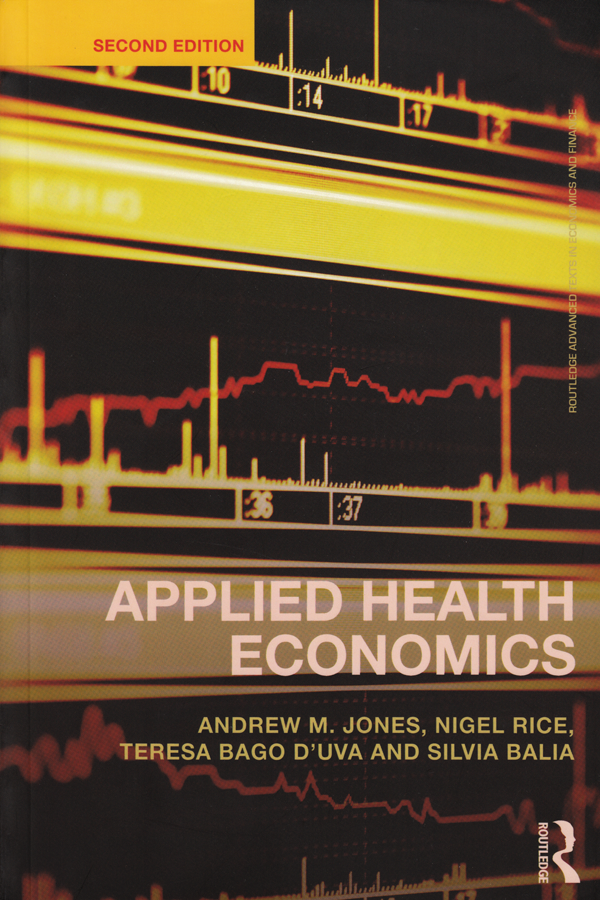
Applied Health Economics

Authors: Andrew Jones, Nigel Rice, Teresa Bago d’Uva, Silvia Balia
Publisher: Routledge
Copyright: 2007
ISBN-13: 978-0-415-39772-8
Pages: 335; paperback
Price: $63.00
See a large photo of the front cover
See the back cover
Table of contents
cover
Review of book from the Stata Journal

Comments from the Stata technical group

Applied Health Economics, by Andrew Jones, Nigel Rice, Teresa Bago d’Uva, and Silvia Balia, shows how to summarize and analyze health-economic data with Stata. The authors teach topics in health economics by defining and asking real questions of real data with Stata. The book includes all the Stata code used in the analyses, and the authors carefully interpret the output. Applied Health Economics lives up to its name by teaching through application.

This book is an excellent choice for anyone interested in empirical health economics. It offers a nice introduction for graduate students and useful discussions and modeling strategies for more advanced researchers. The wealth of Stata examples make the book an outstanding resource to researchers analyzing health-economic data with Stata.

Applied Health Economics is nicely organized into parts, which correspond to data types, and chapters within each part, which focus on particular topics in health economics. The coverage is thorough, as the table of contents below makes clear.


Table of contents

List of illustrations
Preface
Acknowledgments
Part I: Data description
1. Data and survey design
1.1 The Health and Lifestyle Survey (HALS)
1.2 The British Household Panel Survey (BHPS)
1.3 The European Community Household Survey (ECHP)
1.4 The Canadian National Population Health Survey (NPHS)
1.5 The WHO Multi-Country Survey Study (WHO-MCS)
1.6 Overview
2. Describing the dynamics of health
2.1 Introduction
2.2 Graphical analysis
2.3 Tabulating the data
3. Inequality in health utility and self-assessed health
3.1 Introduction
3.2 Distribution analysis
3.3 Regression analysis of HUI: Ordinary Least Squares (OLS)
3.4 Regression analysis of SAH: ordered probit model
3.5 Combined analysis of HUI and SAH: interval regression
3.6 Overview
Part II: Categorical data
4. Bias in self-reported data
4.1 Introduction
4.2 Vignettes
4.3 Standard ordered probit model
4.4 Using vignettes to control for heterogeneous reporting
5. Health and lifestyles
5.1 Introduction
5.2 HALS data and sample
5.3 Descriptive analysis
5.4 Estimation strategy and results
5.5 Overview
Part III: Survival data
6. Smoking and mortality
6.1 Introduction
6.2 Basic concepts of survival analysis
6.3 The HALS data
6.4 Survival data in HALS
6.5 Descriptive analysis
6.6 Duration models
7. Health and retirement
7.1 Introduction
7.2 Preparing and summarizing the data
7.3 The endogeneity of health
7.4 Empirical approach to duration modelling
7.5 Stock sampling and discrete-time hazard analysis
7.6 Overview
Part IV: Panel data
8. Health and wages
8.1 Introduction
8.2 BHPS sample and variables
8.3 Empirical model and estimation
8.4 Overview
9. Modelling the dynamics of health
9.1 Introduction
9.2 Static models
9.3 Dynamic models
10. Non-response and attrition bias
10.1 Introduction
10.2 Static models
10.3 Estimation
11. Models for health-care use
11.1 Introduction
11.2 The Poisson model
11.3 The Negative Binomial model
11.4 Zero inflated models
11.5 Hurdle models
11.6 Finite mixture/latent class models
11.7 Latent class hurdle model
Bibliography
Index
Bookmark and Share 
Bookstore
Overview
Documentation
Books on statistics
Top-selling books
Browse by author
Browse by title
Browse by subject
Books on Stata
Books by Stata Press
Stata Journal
STB Reprints
Book search


Advanced search tips
Like us on Facebook Follow us on Twitter Follow us on LinkedIn
Follow us
© Copyright 1996–2012 StataCorp LP   |   Terms of use   |   Privacy   |   Contact us   |   Site index   |   View mobile site